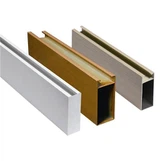
Aluminum rectangular tubes are widely used in various industries due to their excellent properties, including high strength - to - weight ratio, corrosion resistance, and good formability. One of the key properties that often determines their suitability for specific applications is thermal conductivity. In this blog, as a supplier of aluminum rectangular tubes, I will delve into the thermal conductivity of these tubes, exploring what it is, how it is measured, and why it matters.
Understanding Thermal Conductivity
Thermal conductivity, denoted by the symbol (k), is a measure of a material's ability to conduct heat. It is defined as the quantity of heat, (Q), that passes through a unit area, (A), of a material in a unit time, (t), under a unit temperature gradient, (\Delta T/\Delta x). Mathematically, it is expressed as (Q = - kA\frac{\Delta T}{\Delta x}t), where the negative sign indicates that heat flows from a higher - temperature region to a lower - temperature region.
The SI unit of thermal conductivity is watts per meter - kelvin ((W/(m\cdot K))). A high thermal conductivity value means that the material can transfer heat quickly, while a low value implies poor heat transfer capabilities.
Thermal Conductivity of Aluminum
Aluminum is known for its relatively high thermal conductivity. Pure aluminum has a thermal conductivity of approximately (237 W/(m\cdot K)) at room temperature. This high thermal conductivity is due to its atomic structure. Aluminum has a face - centered cubic (FCC) crystal structure, which allows for efficient movement of free electrons. These free electrons play a crucial role in heat transfer, as they can carry thermal energy from one part of the material to another.
However, when it comes to aluminum rectangular tubes, the thermal conductivity can vary depending on several factors, such as the alloy composition and the temper of the aluminum.
Influence of Alloy Composition
Most aluminum rectangular tubes are made from aluminum alloys rather than pure aluminum. Alloying elements are added to enhance certain properties, such as strength, corrosion resistance, and machinability. But these alloying elements can also affect the thermal conductivity of the aluminum.


For example, the 6061 T6 Aluminum Rectangular Tubing is a popular alloy. The 6061 alloy contains magnesium and silicon as the main alloying elements. The addition of these elements reduces the thermal conductivity compared to pure aluminum. The thermal conductivity of 6061 aluminum alloy is around (167 - 173 W/(m\cdot K)).
Another common alloy is 6063 T52 Aluminum Rectangular Tube. The 6063 alloy has a lower magnesium and silicon content compared to 6061. As a result, it has a slightly higher thermal conductivity, typically in the range of (201 - 209 W/(m\cdot K)).
Effect of Temper
The temper of the aluminum also has an impact on its thermal conductivity. Temper refers to the heat treatment and mechanical working processes that the aluminum has undergone. For example, a fully annealed aluminum tube (soft temper) may have a different thermal conductivity compared to a strain - hardened or precipitation - hardened tube.
In general, heat - treating processes that involve precipitation hardening can introduce fine particles within the aluminum matrix. These particles can act as scattering centers for free electrons, reducing the efficiency of heat transfer and thus lowering the thermal conductivity.
Measuring Thermal Conductivity
There are several methods to measure the thermal conductivity of aluminum rectangular tubes. One of the most common methods is the steady - state method. In this method, a known heat flux is applied to one end of the tube, and the temperature difference across a known length of the tube is measured. By using Fourier's law of heat conduction, the thermal conductivity can be calculated.
Another method is the transient method, which measures the time - dependent temperature change in the material after a sudden heat input. Transient methods are often faster and more suitable for measuring small samples or materials with non - uniform properties.
Importance of Thermal Conductivity in Applications
The thermal conductivity of aluminum rectangular tubes is a critical factor in many applications.
Heat Exchangers
In heat exchanger applications, the ability to transfer heat efficiently is of utmost importance. Aluminum rectangular tubes with high thermal conductivity are ideal for use in radiators, condensers, and evaporators. They can quickly transfer heat from a hot fluid to a cold fluid, improving the overall efficiency of the heat exchanger.
Electronics Cooling
With the miniaturization of electronic devices, effective heat dissipation has become a major challenge. Aluminum rectangular tubes can be used as heat sinks to dissipate heat generated by electronic components such as CPUs and power amplifiers. Their high thermal conductivity allows them to absorb and transfer the heat away from the sensitive electronic parts, preventing overheating and ensuring reliable operation.
Building and Construction
In building and construction, aluminum rectangular tubes are used in applications where thermal management is required. For example, in curtain walls and window frames, tubes with appropriate thermal conductivity can help regulate the temperature inside the building, reducing energy consumption for heating and cooling.
Our Offerings
As a supplier of aluminum rectangular tubes, we offer a wide range of products with different alloy compositions and tempers to meet the diverse needs of our customers. Our Aluminum Alloy Square Tubes Rectangle Pipe are carefully manufactured to ensure consistent quality and performance.
Whether you need tubes for high - heat - transfer applications or for structural purposes, we can provide you with the right solution. We understand the importance of thermal conductivity in your projects and can assist you in selecting the most suitable aluminum rectangular tubes based on your specific requirements.
Conclusion
The thermal conductivity of aluminum rectangular tubes is a complex property that is influenced by factors such as alloy composition and temper. While pure aluminum has a high thermal conductivity, alloying elements and heat - treating processes can modify this property. Understanding the thermal conductivity of these tubes is crucial for selecting the right material for various applications, from heat exchangers to electronics cooling.
If you are interested in our aluminum rectangular tubes and would like to discuss your specific needs, please feel free to contact us for a detailed consultation. We are committed to providing you with high - quality products and excellent service.
References
- Callister, W. D., & Rethwisch, D. G. (2014). Materials Science and Engineering: An Introduction. Wiley.
- ASM Handbook Volume 2: Properties and Selection: Nonferrous Alloys and Special - Purpose Materials. ASM International.